Property Condition AI
Listing photos already show if a house is tired or freshly finished. Property Condition AI reads those photos and gives three scores: how worn it looks, how fancy the materials are, and where the score could sit if the weak part were brought up to match the rest. The numbers on this page are samples. It does not run a live model.
Property Condition AI ↗- Customer: Someone pricing a house, or comparing it with a similar one.
- Problem: The photos show the wear, but the file still treats every house as average.
- Solution: Three scores from the photos: wear, materials, and where the weak part could sit if it matched the rest.
- Outcome: On one sample house, overall wear is 2.9 and the read is 63% sure from 6 photos. 1 is heavy wear and 6 is excellent.
- Strategic win: The weak spot is written down before a visit. These numbers are samples, not a live model.
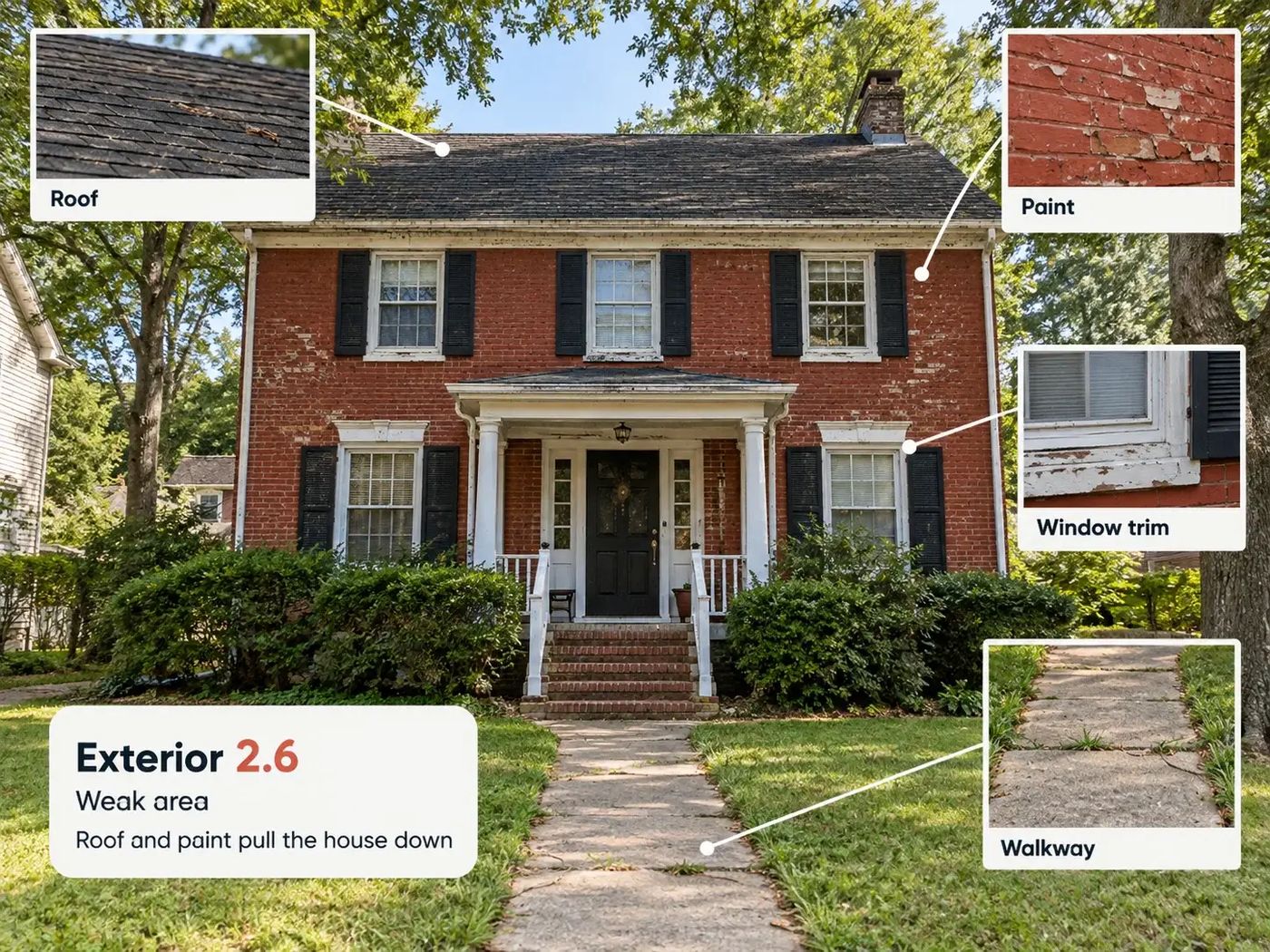
The photos know the house is tired. The price file does not.
Someone pricing a house, picking a similar one, or deciding if it is ready to rent still has to guess the wear by opening every photo.
Why it was hard
A price guess that never sees photos treats a fresh kitchen and a tired house as the same address. Pretty bedroom photos can hide a worn roof. The hard part is scoring every house the same way, from the pictures alone.
- Wear and fancy materials are different. A clean laminate counter is still a basic material
- One new kitchen can hide worn baths and a tired front
- A listing that skips the front, the kitchen, or the baths is a weaker read
- The score if you fixed the weak part is a sample, not a promise of the sale price
What you get
- ✓Wear you can see: paint, floors, fixtures, roof, and how tired the room looks
- ✓Finishes are the materials, not how clean the room is. Basic laminate scores below stone, thick trim, and custom cabinets
- ✓Update room is a sample of the score if the weak area were brought in line with the stronger rooms
- ✓Scores for the whole house, the kitchen, the baths, the inside, and the outside
- ✓A confidence number that drops when photos are missing or too tight to judge the room
- ✓On the 180 Charles Boulevard sample, 1 is heavy wear and 6 is excellent
Three ways to read a photo
Wear is what looks tired: paint, floors, fixtures, and the roof. Finishes are the materials, so a basic counter scores below stone or custom cabinets even if the room is clean. Update room asks a what-if: where could the score sit if the weak part were brought up to the stronger rooms.
Open Property Condition AI →One sample house
180 Charles Boulevard is one sample, with 6 photos. Wear is 2.9 overall, 2.7 in the kitchen, 2.8 in the baths, 3.1 inside, and 2.6 outside. The outside is the weak spot: the front and the roof pull it down. Confidence is 63%. If that weak part were brought in line, the sample update score is 4.7. Two other samples sit on the list: 22 Mesa Court at 4.7 wear from 6 photos, and 605 Main Street at 3.8 from 7 photos.
See the sample house →What the numbers are for
A price model can stop treating every house as average. A similar-house search can avoid pairing a new kitchen with a house that only matches on paper. A buyer can see rent-ready, light updates, or a renovation before a visit. Separate kitchen and bath scores show when one new room is hiding the rest.
Property data work →The photo already has the wear. The score just writes it down.
On this sample, 1 means heavy wear and 6 means excellent. The read gets less sure when the listing skips the front, the kitchen, or the baths, or when a photo is too close to judge the room.
These scores are prepared samples for three listings. The page does not run a live model. Comparison figures on the public property condition page, such as valuations up to 10% more accurate and up to an 18% drop in average error for a computer price guess, belong to that page. They are not a result from this sample.
Open Property Condition AI ↗