On this page
Introduction
TL;DR
Jina Reader converts messy URLs into clean Markdown for LLMs. Embeddings capture deep context (up to 8k tokens). Reranker re-sorts search results to ensure only the most relevant data reaches your AI, massively reducing hallucinations.
In the era of Large Language Models (LLMs) and Retrieval-Augmented Generation (RAG), data quality is king. Traditional search engines and scraping tools often feed LLMs with messy HTML, ads, and irrelevant noise, leading to hallucinations and poor answers.
Enter Jina AI. It's not just a search tool; it's a complete Search Foundation designed specifically for the AI era. From turning any URL into clean markdown to reranking search results for maximum relevance, Jina AI provides the critical infrastructure needed to build production-grade RAG applications.
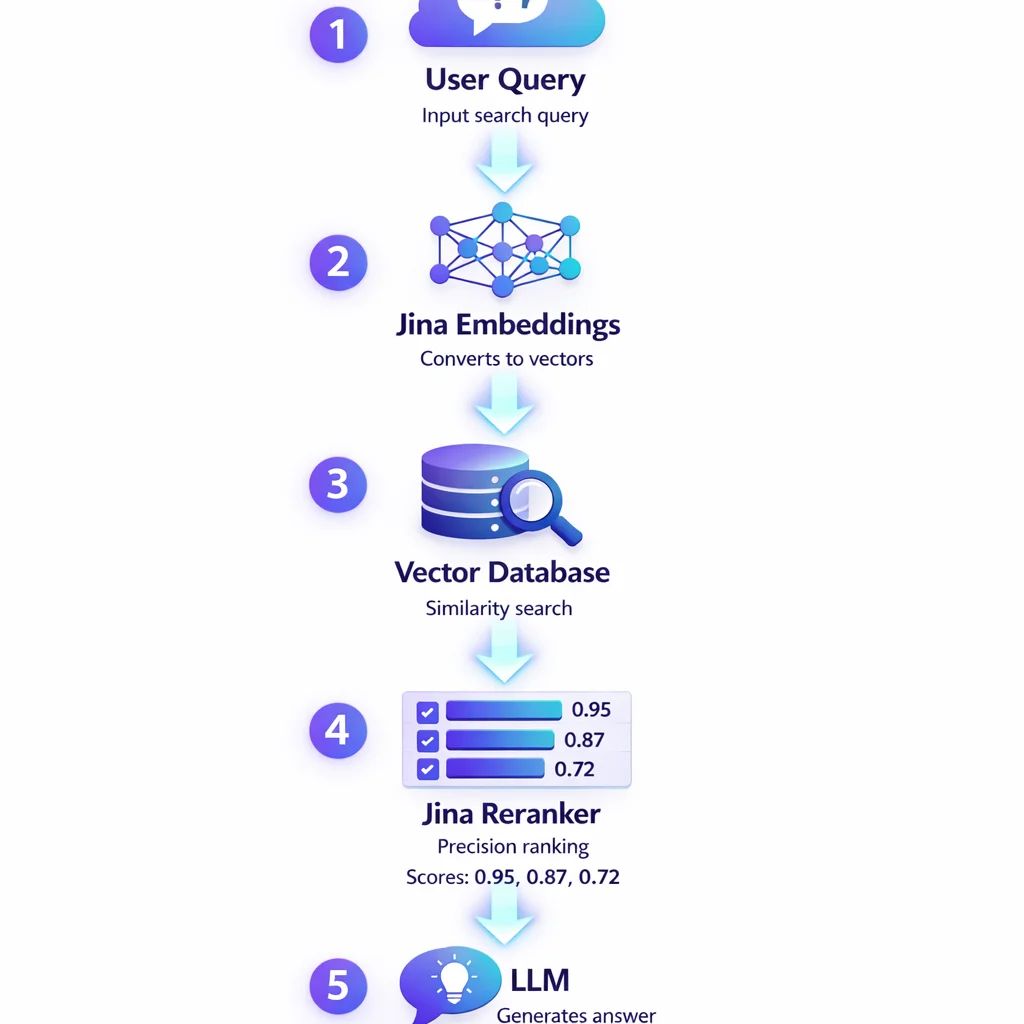
Figure: The RAG Pipeline powered by Jina AI
Jina Reader: The Web to LLM Bridge
The Jina Reader API (`r.jina.ai`) is arguably the simplest yet most powerful tool for AI developers. It takes any URL and converts it into LLM-friendly clean text or markdown, stripping away the clutter.
r.jina.ai
Intelligent Parsing Engine
# Main Title

## Section 1
Clean content extracted...

* Important List Item
Why use it?
- No API key required for basic usage (free tier).
- Handles dynamic content without bulky Puppeteer scripts.
- Reduces token input costs for GPT-4 by removing noise.
Embeddings: Multilingual Context
Jina Embeddings are state-of-the-art text embedding models. Unlike OpenAI's disparate models, Jina's embeddings are multilingual by design and support massive 8k context lengths.
Long Context (8k)
Process entire legal documents or research papers in a single pass, capturing global dependencies that short-context models miss.
Bilingual & Multilingual
Highly optimized for English-German, English-Chinese, and 30+ other languages, making it ideal for global enterprise search.
Reranker: The Accuracy Booster
This is the "secret sauce" of high-performance RAG systems. A vector search might return top 100 results that are somewhat relevant, but a Reranker actually reads the query and the documents to sort them by true relevance.
Fast but Approximate
Cross-Encoder Precision
Highly Relevant Only
Step-by-Step Implementation
Using Jina Reader with Python
import requests

# 1. Simply prepend https://r.jina.ai/ to ANY URL
target_url = "https://en.wikipedia.org/wiki/Artificial_intelligence"
jina_url = f"https://r.jina.ai/{target_url}"

# 2. Make the request
response = requests.get(jina_url)

# 3. Get clean Markdown
markdown_content = response.text

print(markdown_content[:500])
# Output: # Artificial intelligence
# Artificial intelligence (AI) is intelligence...
CLI Usage (cURL)
curl https://r.jina.ai/https://example.comFrequently asked questions
Is Jina Reader free?
Yes, Jina Reader has a generous free tier that requires no API key. For higher rate limits and enterprise features, paid plans are available.
What is the difference between Embedding and Reranker?
Embeddings turn text into numbers (vectors) for fast retrieval of "similar" items. Rerankers take those retrieved items and carefully "read" them against the query to sort them by true meaning. Rerankers are slower but much more accurate.
Does Jina work with LangChain?
Absolutely. Jina has first-class integrations with LangChain, LlamaIndex, and Haystack, making it easy to drop into existing pipelines.


 MD Kawsar· September 26, 2026 · 10 min read