On this page
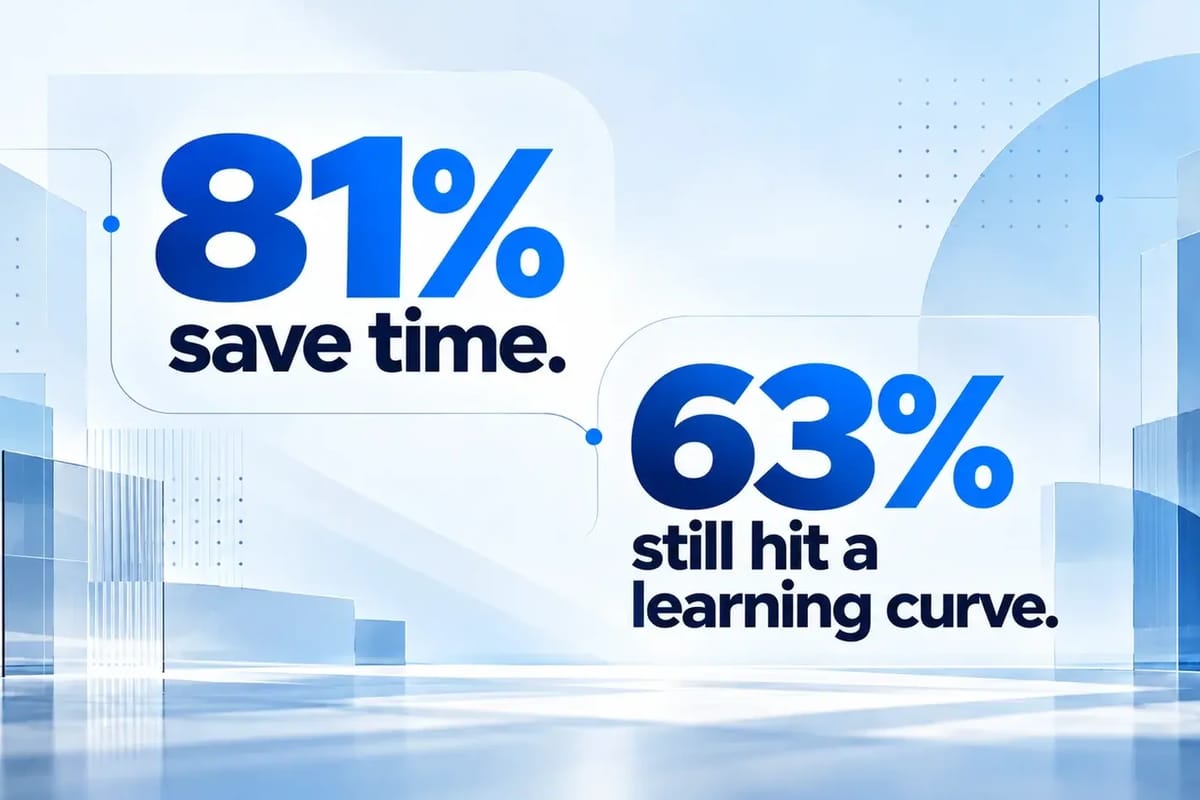
81% save time. 63% still hit a learning curve
Why Realtors adopt tech: 81% save time, 63% learning curve. That is the contrast in the National Association of REALTORS® newsroom release dated September 22, 2026 on the 2026 REALTORS® Technology Report. Eighty-one percent said saving time is their primary goal in embracing new technology, up from 66% a year ago. Sixty-three percent said the learning curve is their biggest challenge in adopting new technology, and 59% pointed to cost.
The REALTORS® Technology Report hub repeats the time priority in its key findings: saving time remains the primary reason for adopting new technology, and eighty-one percent of REALTORS® reported embracing new technology primarily to improve efficiency and productivity. A separate NAR news article on the same report says the findings are based on responses from 1,200 agents, and that the report surveyed NAR members.
Full survey question wording and field dates are not printed on the newsroom page, the report hub, or the news article we opened. This post does not invent them. It sticks to the percentages and labels those pages publish, with links to each source.
Why agents say they adopt technology
The newsroom frames adoption as a practical choice. Agents want time back and a smoother experience for clients. The same release lists five reasons under "Why Agents Adopt Technology," each with a percentage:
- Saving time: 81%
- Improving client experience: 71% (up from 64% in 2025)
- Closing more deals: 57%
- Less manual work: 54%
- Staying ahead of competition: 44%

Those five numbers are not a ranking of product categories. They are self-reported goals for embracing new technology. The 81% line is about the primary goal of saving time. It is not a claim that 81% of agents use artificial intelligence, and this post does not treat it that way.
The NAR news article uses a related framing for tool choice: when deciding what to use, 81% of agents say they prioritize tools that help them save time, followed by 71% who say they look for tools that will improve the client experience. That sentence sits on the news article. The headline percentages in this post stay pinned to the newsroom wording for primary goal and biggest challenge.
Jessica Lautz, NAR deputy chief economist, is quoted on the newsroom page saying agents are making practical choices, and that the two payoffs they want most are time and a smoother experience for their clients. Those priorities, the quote says, have grown stronger over the past year. When routine work gets handled faster, agents have more time for guidance, negotiation, and advice through a major financial decision. That is NAR's framing of the same report, not an outside ranking.
The learning curve and the cost
Wanting time is not the same as getting it without friction. The newsroom states both sides in one sentence: sixty-three percent of agents said the learning curve is their biggest challenge in adopting new technology, and 59% pointed to cost.

The news article describes the same pain points without reprinting the 63% figure in the excerpt we used: agents say their biggest pain point when adopting new technology is the learning curve, followed by cost and having too many options to choose from. For the 63% and 59% numbers, this post keeps the newsroom as the primary link.
Spend sits next to that friction. Among the 1,200 agents in the news article, about half say they budget between $50 and $500 monthly for technology. Twenty-two percent spend more than $500 monthly. Eighteen percent spend less than $50 per month. The newsroom breaks the middle band into $50 to $250 (36%) and $251 to $500 (19%), with the same 18% under $50 and 22% over $500. Those are monthly technology budgets as reported, not a claim about what any one tool should cost.
Client reaction is mixed in a useful way. On the newsroom page, 40% of agents said their clients responded very positively to technology in the buying and selling process, and another 37% said clients found it helpful while voicing some reservations. The report hub key findings also state that forty percent of REALTORS® said their clients responded very positively to the use of technology throughout the home buying and selling process. Positive response from clients does not cancel the learning curve on the agent side. Both can be true in the same survey.
What AI use looks like in the same report
Artificial intelligence is part of the same 2026 report, but it is a separate set of percentages from the 81% time goal. The newsroom says nearly half of agents now use AI daily (23%) or weekly (25%), and just 12% say they are not using it and have no plans to, down from the 32% who had not yet tried AI in 2025. The report hub key findings also state that twenty-three percent of REALTORS® reported using AI tools daily in their business activities.
Among people who use AI, the news article says 55% say it has had a positive impact on their business. The report hub key findings put the same 55% this way: fifty-five percent of respondents said AI has had a positive effect on their real estate business. Either way, 55% is not 81%, and it is not a claim that every agent runs AI every day.
Where AI shows up in the workflow is mostly writing and follow-up. Among agents who use AI, the newsroom lists writing listing descriptions at 75%, social media posting at 56%, and creating emails or follow-up at 52%. Market summaries and drafting marketing content with a personal tone each sit at 30%. Document review or summarizing is 27%. Those uses match the kind of draft-and-edit work described in BigiByte's AI tools for real estate agents post. They are content and communication jobs, not a substitute for local comps or a signed listing agreement.
Established tools still dominate the "top technologies used" list on the newsroom page: MLS at 96%, e-signature at 79%, showing scheduling tools at 68%, CMA or pricing tools at 59%, drone photography or video at 48%, CRM at 46%, and AI-generated content at 41%. AI-generated content is on that list. It is not the whole list. Agents who say they adopt tech to save time may be pointing at e-signature and scheduling as often as at a chatbot.
What this means in practice for an agent
Read the two headline figures together. An agent who wants time back is not wrong to shop for tools. An agent who hits a learning curve is not failing at that goal. The same survey says both things about the same population of NAR members. The useful question is which part of the job is eating time, and whether a new tool reduces that work or just adds another login.
If the bottleneck is listing copy, social posts, or follow-up drafts, the report's AI use cases point there. Start with one task you already rewrite every week. Measure whether the draft shortens your edit time before you add a second tool. The AI tools for real estate agents post walks through that kind of listing and follow-up work without treating any vendor as a guaranteed win.
If the bottleneck is watching many zip codes and spotting new rows, a chat window is the wrong shape. That job needs a list you control: the zips, the fields, and a sheet that shows whether yesterday's check ran. BigiByte's property tracker case study is one example of that setup for a South Florida client across 30 zip codes. It is a different job from browsing portals. For how portals describe estimates and listings, see Zillow vs Realtor.com vs Redfin. For a wider map of data options, the real estate data solutions guide is the next stop.
Budget the learning curve the way the report budgets spend. If you are in the half that sits between $50 and $500 a month, a tool that needs a week of setup may cost more in hours than in fees. Pick the task first. Then ask how long it takes to learn the workflow well enough that the time goal is real. The 63% figure is a warning about that second step, not a reason to avoid technology altogether.
Client experience sits second on the adoption list at 71%. A tool that saves you twenty minutes but confuses a buyer on a showing link can miss that second goal. The newsroom's 40% "very positive" client response is useful context. It is not a guarantee that every rollout will feel that way. Test the client-facing piece with one transaction before you standardize it.
What the report does not prove
It does not prove that 81% of Realtors use AI. The newsroom meaning of 81% is the primary goal for embracing new technology: saving time. AI daily use is a separate 23% on the same release. Do not merge those lines.
It does not prove that any named product is the right purchase. The report lists categories and self-reported goals. It does not score vendors, and this post does not invent a scoreboard. HousingWire and other outlets covered the same report. The 81% and 63% figures in this draft come from NAR's newsroom, not from secondary coverage.
It does not publish the full questionnaire or the field dates on the pages we opened. If you need the exact question text or when the survey ran, those details are missing from the newsroom, the report hub summary, and the news article used here. Download the full report from NAR if you need more, and do not invent wording to fill the gap.
It does not prove that spending more than $500 a month buys a shorter learning curve, or that spending under $50 avoids one. The spend bands and the challenge percentages sit in the same report. They are not linked as a causal table on the pages cited above.
It does not prove that clients always welcome every new tool. Forty percent of agents reported a very positive client response. Another 37% reported helpful with reservations. The rest of the picture is not spelled out as a single slogan on the newsroom page.
When to ask for help
Use the 2026 REALTORS® Technology Report as a mirror for your own stack. If saving time is your reason for a new tool, write down which hours you want back. If the learning curve is what slows you down, shrink the rollout to one workflow. If the job is a feed or a tracker rather than a writing assistant, say so up front.
BigiByte builds custom trackers and data workflows for agents and teams who already know the zips and fields they need. That is not a claim that custom software replaces MLS, e-signature, or the AI draft tools in the NAR list. It is the other half of the time problem: getting rows into a sheet you trust. To scope that kind of work, use the contact page and send the market, the zips, and what you want on each row. This is not a quote in this post, and it is not a claim that any setup erases the 63% learning-curve challenge on its own.


 MD Kawsar· October 5, 2026 · 10 min read