What Customers Really Think
Sentiment analysis means reading a pile of reviews and sorting each one: happy, mixed, or upset, and naming the reason. What Customers Really Think does that for Amazon product reviews, so a seller can see what to fix without reading thousands of comments.
What Customers Really Think ↗- Customer: A seller who has too many Amazon reviews to read one by one.
- Problem: A star rating hides whether people are upset about the size, the shipping, or the product itself.
- Solution: Each review is marked happy, mixed, or upset, and tagged with the topic people mention.
- Outcome: The loudest complaint and the loudest praise show up as a short list, not a thousand comments.
- Strategic win: The next fix can follow the complaint that keeps coming back.
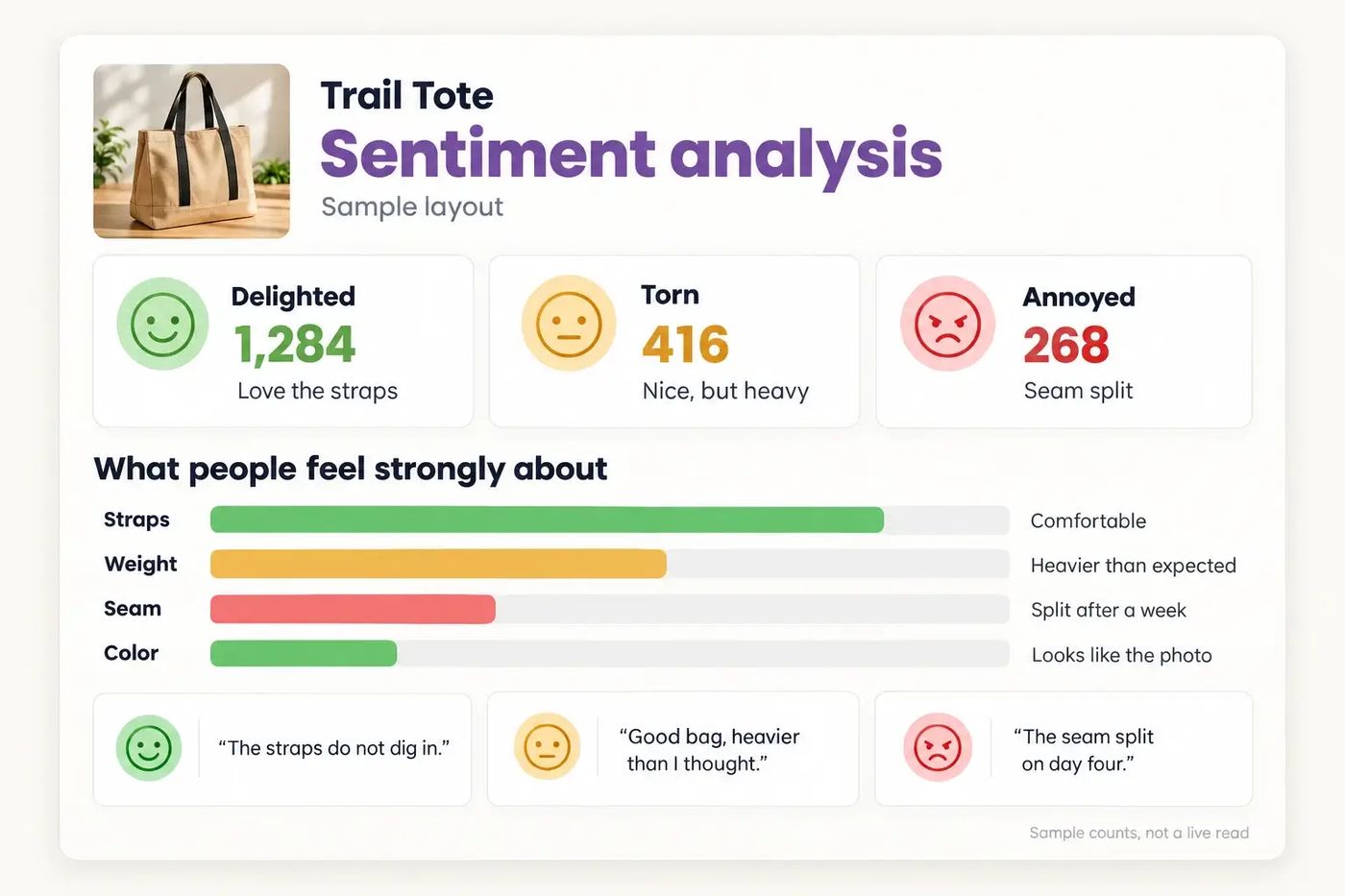
The stars look fine. The comments do not.
Amazon shoppers write the useful part in the comment. A seller who only watches the star average misses the reason people return the product.
Why it was hard
A 4-star average can hide a problem. Half the reviews may love the product while the other half say it arrived broken, and the average still looks fine.
- Thousands of reviews take days to read
- One review can praise the quality and complain about the size
- The same complaint is worded a different way each time
- A new batch of reviews arrives after the last read is finished
What you get
- ✓Happy, mixed, or upset on every review
- ✓How sure that label is
- ✓Topics people repeat, such as quality, size, shipping, and price
- ✓A short list of what they praise and what they complain about
- ✓A spreadsheet of the rows, so the same read can run on the next batch
Three feelings, not one score
Happy means the review praises the product. Upset means it complains. Mixed means both. The label sits on the review, so a 5-star comment that still complains about shipping is not treated as pure praise.
Open What Customers Really Think →The reason, not only the mood
The same read groups the words people keep using: quality, size, shipping, price, and anything else that shows up often. A seller can see that shipping is the loud complaint even when the product itself is praised.
See the sample →Use it on the next batch
The first read shows what to fix. The same steps can run when new Amazon reviews arrive, so last month's complaint is not the only one you know about.
Review reading →Read the feeling and the reason, not only the stars.
Sentiment analysis sorts Amazon reviews into happy, mixed, and upset, then names what people are actually talking about.
The gallery pictures use a sample layout and sample counts. The linked page shows real customer lines for Amazon subscription boxes. A higher score means a happier review.
Open What Customers Really Think ↗