On this page
Introduction
Every day, millions of bots crawl the web extracting data. While some are legitimate (like search engines), others steal your content, undercut your pricing, or harvest user data.
This guide provides actionable strategies to detect, prevent, and mitigate unwanted scraping—protecting your business, users, and competitive advantage.
The Cost of Unprotected Data
- Competitors copying your product catalog and pricing
- Content farms republishing your articles
- Lead generation companies harvesting user emails
- Server costs from bot traffic (sometimes 30-50% of requests)
- SEO damage from duplicate content
Step 1: Detecting Scrapers
Before you can block scrapers, you need to identify them. Look for these signals:
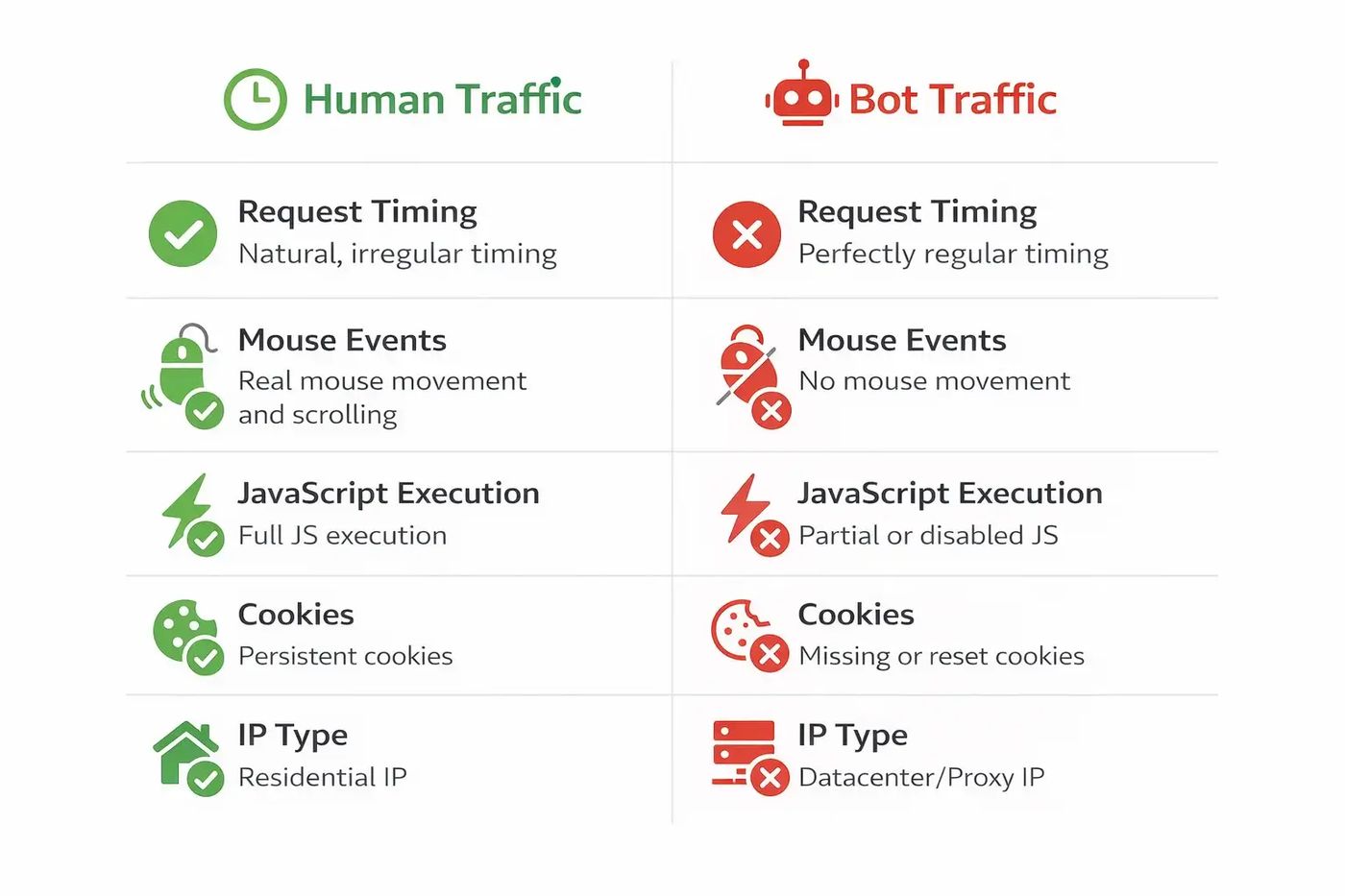
Comparing Bot vs Human Traffic Patterns
Request Patterns
- • Unusually high request rate (100+ req/min)
- • Requests at fixed intervals (every 5 seconds exactly)
- • Sequential page access (page 1, 2, 3, 4...)
- • Requests outside business hours (3 AM local time)
Technical Fingerprints
- • Missing or generic User-Agent strings
- • No JavaScript execution
- • Missing cookies/session data
- • Datacenter IP addresses (AWS, DigitalOcean)
Behavioral Signals
- • No mouse movements or scrolling
- • Zero time between page loads
- • Accessing hidden honeypot links
- • Ignoring robots.txt directives
Traffic Analysis
- • Single IP hitting many pages rapidly
- • Requests only for data-heavy pages
- • Never requesting CSS, JS, or images
- • Identical session fingerprints across IPs
Step 2: Rate Limiting
The simplest and most effective first line of defense. Limit requests per IP, session, or account.
Implementation Strategies
60
Requests/minute per IP
1,000
Requests/hour per session
10,000
Requests/day per account
Tools & Implementation
- Nginx:
limit_req_zonedirective - Express.js:
express-rate-limitmiddleware - Django:
django-ratelimitpackage - Cloudflare: Built-in rate limiting rules
- Redis: Token bucket algorithm for distributed apps
Step 3: CAPTCHA Implementation
CAPTCHAs challenge users to prove they're human. Use them strategically—not on every page.
When to Show CAPTCHA
- After rate limit threshold exceeded
- Suspicious behavioral patterns detected
- Before accessing high-value data
- On login after failed attempts
- Before form submissions
Best CAPTCHA Solutions
- reCAPTCHA v3: Invisible, score-based (Google)
- hCaptcha: Privacy-focused, pays publishers
- Cloudflare Turnstile: Free, privacy-friendly
- FunCaptcha: Game-based challenges
Warning: Overusing CAPTCHAs hurts UX and frustrates real users. Use sparingly and only when suspicious activity is detected.
Step 4: JavaScript Rendering
Most simple scrapers don't execute JavaScript. Render content client-side to block them.
Techniques
- Client-Side Rendering: Use React, Vue, or Angular to render data dynamically
- Delayed Loading: Load sensitive data after a JS check confirms browser execution
- Obfuscated Data: Send encrypted/encoded data that JS decodes
- Dynamic Class Names: Change CSS class names on each page load
Example: JS-Required Data Load
// Only load prices after JS confirms human-like behavior
setTimeout(() => {
  if (hasMouseMoved && hasScrolled) {
    fetchPrices();
  }
}, 2000);
Step 5: Honeypot Traps
Hidden links or fields that real users never see or interact with—but bots do.
How Honeypots Work
- Add invisible links hidden via CSS (
display: none) - Bots parsing HTML will follow these links
- Humans using browsers will never see them
- Log and block any IP that accesses honeypot URLs
Implementation Example
<!-- Hidden honeypot link -->
<a href="/trap/sweet-data"
   style="display:none;position:absolute;left:-9999px;">
  Click for exclusive data
</a>

<!-- Form honeypot field -->
<input type="text" name="website"
       style="display:none" tabindex="-1" autocomplete="off">

<!-- Server: Block if "website" field is filled -->
Step 6: Browser Fingerprinting
Collect browser attributes to create a unique fingerprint, detecting bots even if they rotate IPs.
Fingerprinting Attributes
Tools for Fingerprinting
- FingerprintJS: Comprehensive open-source library
- PerimeterX: Enterprise bot detection
- DataDome: Real-time bot protection
Step 7: API Protection
If you expose APIs (even internal ones), they're prime scraping targets. Protect them.
Authentication
- Require API keys for all endpoints
- Use short-lived JWT tokens
- Implement OAuth 2.0 for third parties
- Rotate API keys periodically
Request Validation
- Validate referrer headers
- Check origin against allowlist
- Use signed request parameters
- Implement request nonces
Response Best Practices
- • Paginate responses (max 50 items per request)
- • Add artificial delays for large datasets
- • Watermark data with account-specific markers
- • Monitor for unusual access patterns per API key
Step 8: WAF & Bot Management Services
For serious protection, use a dedicated Web Application Firewall (WAF) with bot management.
Cloudflare
Most popular. Free tier available.
- Bot Fight Mode (free)
- Super Bot Fight Mode (Pro)
- Rate limiting rules
- JS challenge for suspicious traffic
AWS WAF + Shield
Deep AWS integration.
- Managed rule groups
- Bot Control add-on
- Rate-based rules
- DDoS protection (Shield)
Akamai Bot Manager
Enterprise-grade solution.
- AI-powered detection
- Device fingerprinting
- Custom bot policies
PerimeterX / DataDome
Specialized bot protection.
- Real-time detection
- Behavioral analysis
- Account takeover prevention
Step 9: Legal Protection
Technical measures aren't enough. Establish legal grounds to pursue scrapers if needed.
Legal Checklist
- Terms of Service: Explicitly prohibit scraping, automated access, and data harvesting
- robots.txt: Document which paths are disallowed (evidence of notice)
- Copyright Notice: Register copyrights for original content
- Access Logs: Maintain detailed logs for evidence in legal proceedings
- Cease & Desist Template: Have a lawyer-approved template ready
Pro Tip: Even if you don't plan to sue, a formal cease-and-desist letter stops most scrapers. They don't want legal trouble.
Frequently asked questions
Can I completely stop all scraping?
No. Determined scrapers with resources can bypass most protections. The goal is to make it expensive and time-consuming enough that it's not worth their effort. Layered defenses raise the bar significantly.
Will these measures hurt SEO?
Some can. Blocking all bots blocks search engines too. Always allowlist Googlebot, Bingbot, and other legitimate crawlers. Use robots.txt properly. Test your protections don't affect search ranking.
What's the ROI of anti-scraping measures?
Hard to measure directly, but consider: reduced server costs (30-50% of traffic can be bots), protected pricing strategy, content originality maintained, and reduced risk of data breaches. For e-commerce and data-heavy sites, the ROI is significant.


 MD Kawsar· September 26, 2026 · 10 min read